

Avahan Maimaiti lives in Tumxuk, the desert region of Xinjiang, China. After an accident left her with permanent disabilities, and after a divorce and a period of severe depression, she depended on her elderly parents to care for her and her two-year-old daughter. Today an enterprise that came to her region—and its unusual business model—has transformed her life.
That enterprise began with Zhang Wenmao, a wealthy businessman from China’s vibrant southeast. Nearly ready to retire, he visited Xinjiang in 2015 and saw a painful reality. The region produced some of China’s finest long-staple cotton, but most of it was sold elsewhere as a cheap raw material. At the same time, rural surplus labor remained in villages with no stable way to raise income; some people had to travel across the country for higher-paying work. Zhang’s judgment was simple and firm: good cotton should gain value locally, and local people should prosper locally.
A Unique Model
In 2020, Zhang Wenmao founded Tangjin Textile company in Tumxuk. It signed the agreement, built the plant, and began production the same year. Within a few years, more than 8,000 sock-knitting machines were running. Daily capacity exceeded 2.5 million pairs; products were sold in more than 20 countries and regions, and Tangjin became one of the world’s leading single-site sock-production bases.
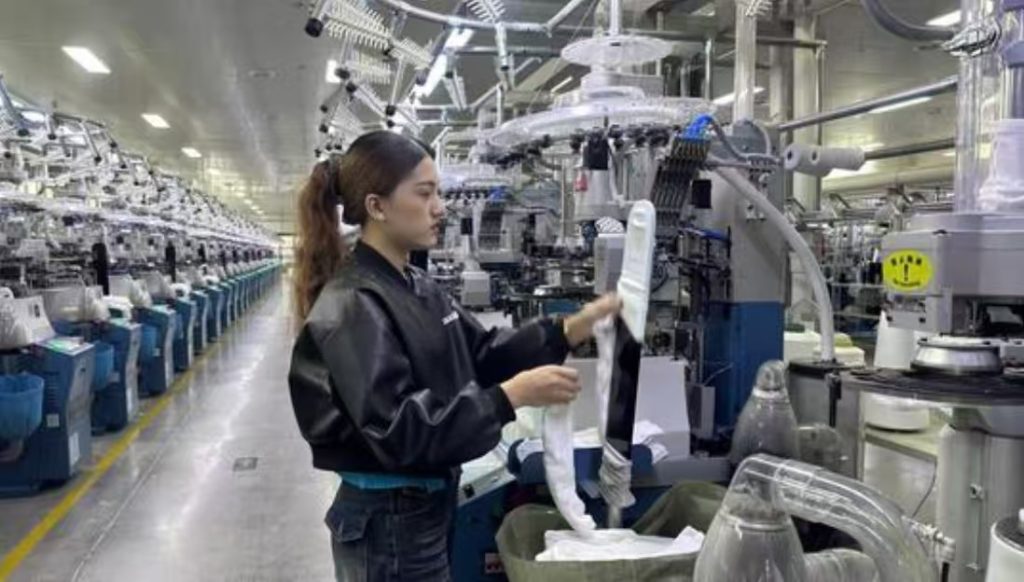
The hardest part of this venture was not building the production capacity. It was people.
Local people in southern Xinjiang had traditionally made their living mainly from farming and herding. Their initial attitude toward factory work was far from welcoming. Some questioned it; some waited to see. Even among those who entered the factory, some disappeared after payday and returned when the money ran out. Some female workers came and went as they pleased. Managing the workforce became almost impossible. Changing habits would take far longer than leveling sand dunes and building roads and factories.
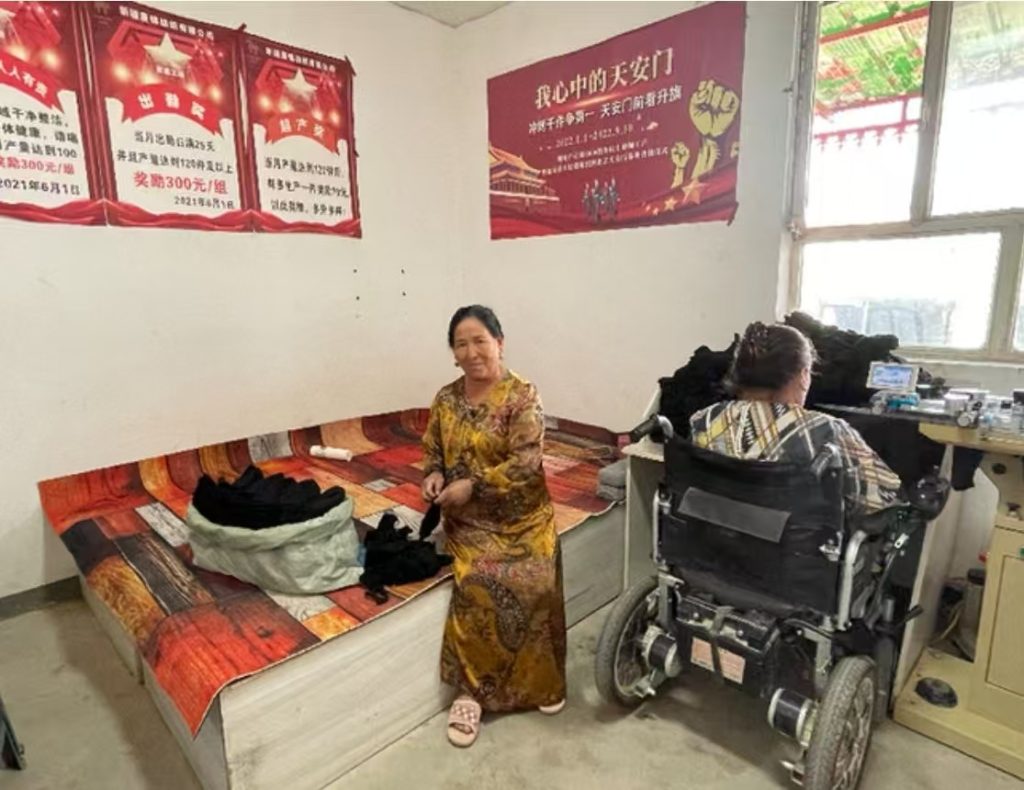
Zhang did not use fines and rules to force compliance. He decentralized production. Tangjin introduced a “headquarters + family workshop + farmer household” model. It separated simple, easy-to-learn finishing processes—seaming, sock turning, shaping—from the assembly line, installed small machines in farmers’ homes at no cost to the households, delivered raw materials, and collected finished products centrally. People could earn piece-rate wages at home or go to a nearby workshop. They controlled their own time.
Avahan and her mother split the work: one sews toe seams, the other turns socks. Together, they now earn an income without stepping outside their house. They can build a new life and earn enough to live comfortably. Although she uses a wheelchair, Avahan tells people her biggest dream is to visit Beijing. When Zhang heard this, he started a new practice: offering outstanding workers all-expenses-paid trips to Beijing.
Another woman, Zhuligu Abula, converted her idle vegetable greenhouse into a cotton-sock workshop. Equipment was installed at no cost to her; she was responsible only for recruiting neighboring women. Whenever other women had to step away for family matters, she stepped in. In one year, she earned an additional 50,000 yuan, and the women in her workshop earned up to 40,000 yuan.
The model spread. More than 930 family workshops now reach across Tumxuk and throughout its counties and townships, enabling more than 3,000 people to work from home and earn annual household incomes between 30,000 and 50,000 yuan.
Pahariya Kechik shows what those numbers mean. The job transformed her from a housewife into an industrial worker. Her family income, including her husband’s, rose from a few thousand yuan a year to more than 10,000 yuan a month. They bought an apartment in downtown Tumxuk and a sedan.
When Sanctions Hit
Just as the industrial park was accelerating, export conditions worsened. Trade restrictions affecting Xinjiang cotton and textile products caused Tangjin’s overseas orders to plummet. Tangjin Textile, an export-oriented manufacturer selling to more than 20 countries and regions, was on the verge of collapse.
At the most difficult moment, Zhang put his house up for sale. When workers heard this, they brought in their personal savings—some from money set aside for weddings, school fees, or home repairs—to help the company endure.
Zhang’s response to the crisis was not to retreat but to expand. Tangjin began selling online, opened domestic direct-to-consumer channels, developed scented socks, attended trade shows, built a direct sales team, and opened new export channels. It was like starting over. Eventually, pairs of Xinjiang cotton socks were sent directly from workshops in southern Xinjiang to consumers across the country; more than 60 million pairs were shipped by express delivery alone. The new sales channels absorbed the export shock and increased sales rapidly.
Caring for Families
More sales channels could address the sales challenge, but another problem could not be solved by business logic alone. Family workshops gave women income at their doorsteps, but after school and during holidays, their children still had no one to look after them. Many mothers operating seaming machines worried about their children at home. To respond, the company funded a nonprofit academy, Tangjin Academy, recruiting full-time teachers from across the country and offering reading rooms and free courses in calligraphy, painting, music, and dance to the children of employees and workshop families.
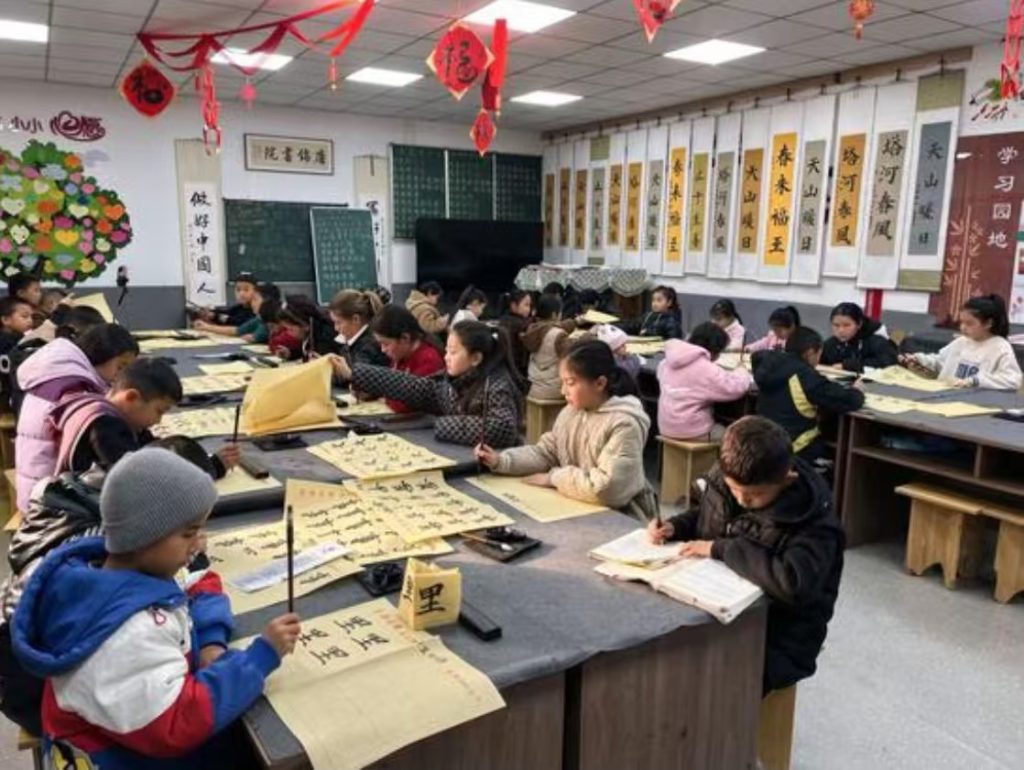
Now eight Tangjin Academy sites are spread across southern Xinjiang, with cumulative investment of more than 6 million yuan. More than 30 full-time teachers have provided free education year-round to more than 400 children of various ethnic groups.
Nine-year-old Munai Zai Aikebaier learned to play a traditional instrument at the academy, and she became more outgoing. Many children from the academy appeared on national television programs to show what they had learned. For Zhang, this investment is a natural move to connect business with community. Employees and children call him “Uncle Zhang.” There is no chairman’s title in that name, yet it carries more weight than any title.
The Lasting Lesson
Tangjin is an outstanding example of rural revitalization and the future of work, showing how business and community are interconnected. One enhances the other. From 2020 to 2024, factory employment grew from 120 to 4,200, with another 3,000 people working in family workshops. Annual sales grew from 30 million yuan to 350 million yuan.
This comes from long-term collaboration between the enterprise and the community. Zhang once said: “When I chose to build a factory in Xinjiang, I was prepared to spend the rest of my life doing this.” He based his decisions not on “How much can this earn?” but on “Is this the right thing to do?” He runs the enterprise on a family-style logic: put yourself in others’ shoes, and treat people as the foundation of the business—not as interchangeable parts. This proved that an enterprise truly becomes profitable and resilient not by making people adapt to business, but by making business respect people.